Trond collapses after the storm
Out Stealing HorsesThe storm that fells the birch in Trond Sander’s yard is followed by an acute spell of dizziness, a fall, and vomiting during his walk with Lyra. The sequence binds an ordinary practical disruption to a sudden confrontation with bodily vulnerability: the storm has left a tree across the yard, but the more unsettling obstruction is Trond’s own uncertain physical state. His chosen solitude, ordinarily a source of independence, becomes a danger when he has no telephone and no immediate way to call for help.
The gale and its aftermath
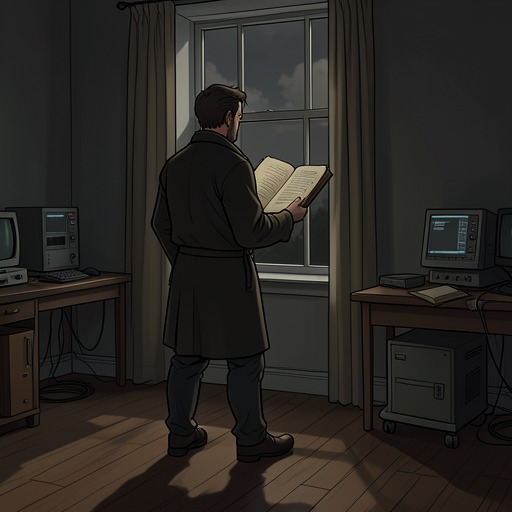
The wind roars through the night, humming along the walls and making the house’s old timbers groan. Trond hears shrill sounds from the forest, metallic rattling, and a crash that he guesses has come from near the shed. He wonders whether the roof slates will hold and imagines them flying across the yard, perhaps denting his car. Warm beneath the duvet, he decides not to get up and returns to sleep. On waking again, he imagines the house as a ship, rocking in the darkness; the transformation lets the storm feel almost pleasurable even as it makes the building seem exposed to the elements.
By morning the wind has stopped, and Lyra’s paws, claws, and drinking are the only sounds Trond hears. The quiet makes the storm’s violence legible by contrast. Looking out from the kitchen, he sees that the large old birch in the yard has been knocked down. Its branches reach nearly to the kitchen window; some rest on the car’s roof rack, while others have torn the shed’s gutter into a V and block the woodshed door. The fallen tree explains the crash he heard overnight. Trond is relieved that the woodbox is full, but the birch has interrupted the routines on which his isolated household depends.
A practical problem becomes a crisis
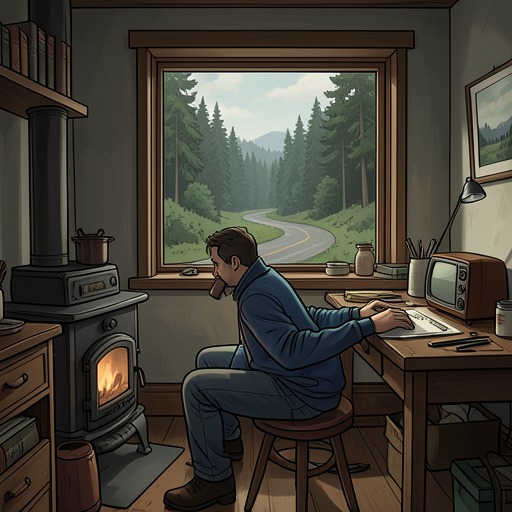
Trond’s first impulse is to go outside, then he recognizes that the tree cannot be moved by simply stepping into the yard. He sits down to plan. The car must be freed and moved; branches must be cleared from the woodshed so he can reach firewood. The chainsaw needs filing after the previous day’s work, and he may need petrol and two-stroke oil. Yet the car he would use to get those supplies is probably trapped by the tree. Each ordinary task depends on another, turning the yard into a knot of practical constraints.
The scale of the birch—large enough to dominate the yard—provokes a panic that Trond cannot account for. He reminds himself that he is there by choice, has food and water, can walk as far as he likes, and is fit. But these reassurances do not settle him. Although he says that he has known for three years that he could die at any moment and has not cared, the fallen tree suddenly makes him feel claustrophobic. He leaves the breakfast table, lies down on the bed in his clothes, against his usual rules, and watches his thoughts churn before settling on the summer of 1948, specifically the day that summer ended.
The return to 1948
The fallen tree does not merely demand physical labor; it opens onto a memory. Trond recalls standing beneath an oak by a shop as wind moved through the leaves, flashing light into his eyes. He remembers the river behind him, which he had heard every day for almost two months, and wonders what it will be like not to hear it anymore. Earlier that morning he and his father had risen early, eaten with little conversation, and walked from the cabin toward the bridge. Passing Franz’s house, Trond saw sunlight fall through the open door, but Franz was absent, and he felt sad to have missed him.
This recalled scene gives the present interruption a second measure of loss. In 1948, Trond’s attention turns toward the river he is about to leave; in the present, the uprooted birch fills the yard and threatens his access to the car and firewood. The narrative moves from a tree that has fallen to a memory of a season ending, without treating the storm as the literal cause of the recollection. Instead, the practical shock becomes the point at which Trond’s mind returns to a day whose significance he could not then know.
The collapse and the walk
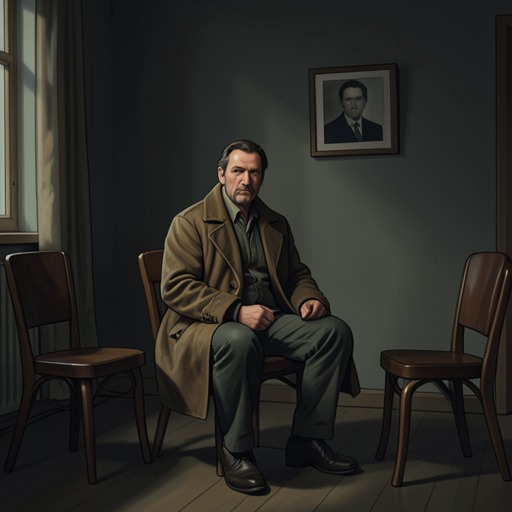
After a short sleep, Trond wakes with a heavy head. When he swings his legs over the bed, dizziness makes him fall forward onto one shoulder. He groans, lies still, and tries to breathe with as little effort as possible. He is sixty-seven and considers himself fit: he walks Lyra three times a day, eats healthily, and has not smoked for twenty years. Still, he fears that he may not be able to move. He has no telephone, a decision he had postponed because he did not want to be accessible; now he recognizes the other side of that choice, that others are not accessible to him either.
Trond eventually rolls onto his knees, uses the door-frame to stand, and waits with his eyes shut until the dizziness passes. Lyra watches him attentively. He tells her, “Good dog,” and decides they will go out. His legs shake as he dresses, but he manages to put on his jacket and boots. He listens closely to his body: apart from nausea, a sore shoulder, and some light-headedness, he thinks that everything seems normal.
He tries not to look at the birch as he makes his way along the house wall, bending branches aside to reach the drive. With Lyra moving ahead, he follows the road toward Lars’s cabin, turns onto the path by the bridge, and continues beside the stream to the river mouth. There he sees the bench where he sat the previous evening, two pale swans on the grey water, bare trees, and forest softened by mist. In the unusual stillness, he hears a sharp snap and then Lyra breathing behind him. The quiet does not hold: nausea overtakes him, and he bends over and vomits onto the withered grass. When Lyra approaches to sniff, he sharply tells her to back off; she runs on and looks back at him. He then reassures her and continues. The episode ends not with an explanation or a recovery, but with the fragile act of carrying on: Trond is unwell, yet the walk proceeds.